


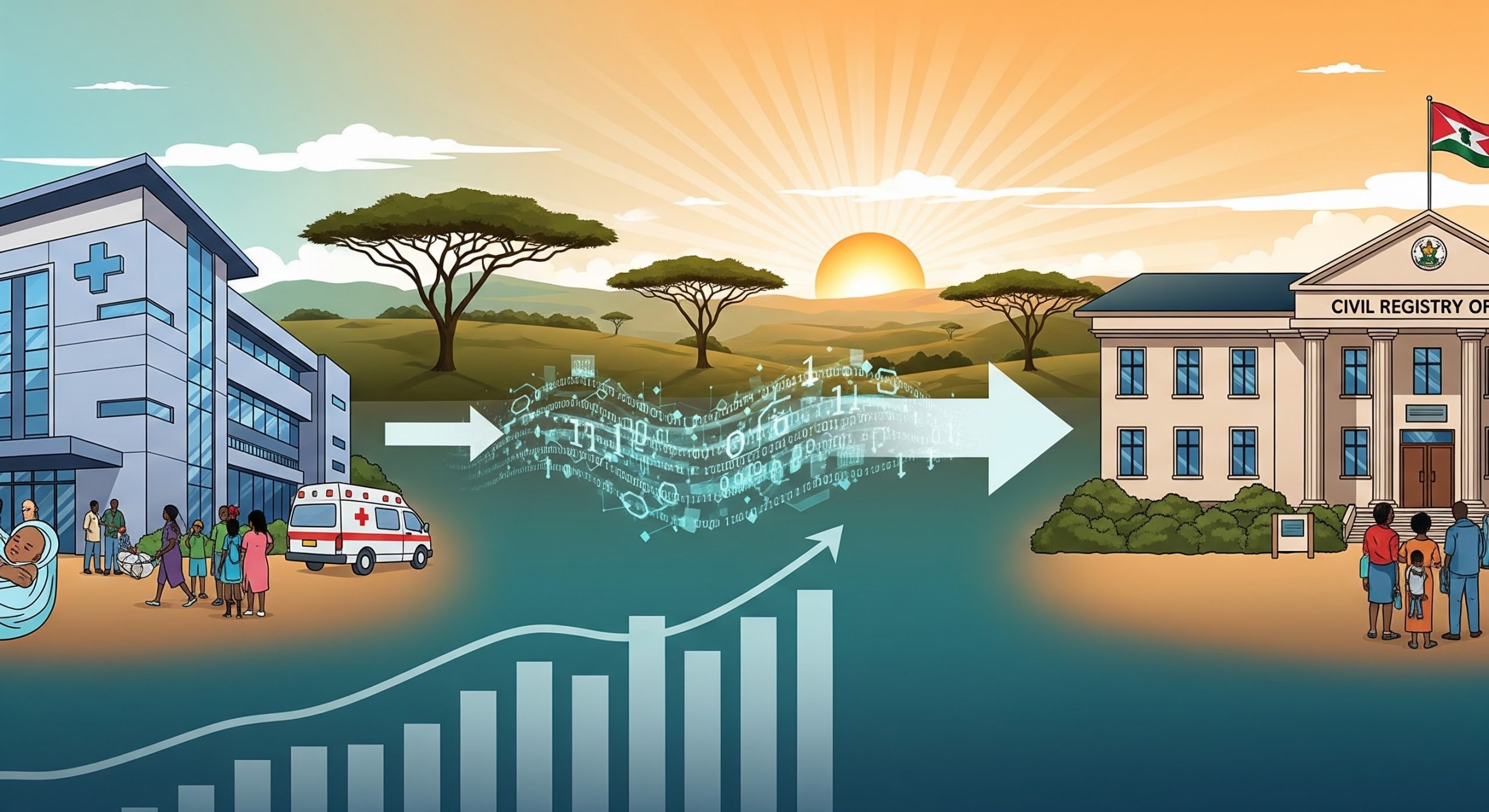
In many developing nations, guaranteeing legal identity for all children is a critical step towards achieving Sustainable Development Goal 16.9 and is fundamental for national planning, budgeting, and ensuring access to essential services like education and health. However, common challenges—such as distance to civil registration services and stringent legal deadlines—often persist, leaving many unregistered.
ALG specializes in providing the quantitative evidence required to accelerate and scale up highly effective interventions. We recognize that high rates of births assisted by a health worker present an excellent entry point for strengthening legal identity programs by creating interoperability between the health system and civil administration.
Our expertise lies in conducting a rigorous Cost-Benefit Analysis (CBA) of these integrated service delivery models, providing strategic decision-support for governments and development partners. This comprehensive approach is designed to inform profitable investments, guide policy, and mobilize the necessary resources for nationwide scaling.
Il 2025, ALG carried out a consultancy in Burundi with UNICEF about: Cost-Benefit Analysis of Investments for Implementing Interoperability between Health Facilities and Civil Registration Services for Birth Registration.
ALG’s Four-Phase Methodology for Quantitative Analysis
Our structured, iterative methodology leverages local expertise and advanced modeling to provide robust, actionable insights:
- Phase 1: Inception, Planning, and Kick-off: We establish project alignment with all stakeholders and conduct a comprehensive review of existing program documents, financial data, and relevant literature on CBA methodologies in Sub-Saharan Africa. This phase culminates in a detailed methodology, outlining the specific framework for identifying and monetizing costs and benefits, as well as developing a detailed work plan. Leveraging national experts is crucial at this stage for navigating local contexts and ensuring data access.
- Phase 2: Data Collection and Comprehensive Analysis: We transition to meticulous data acquisition, building a robust evidence base through mixed methods.
- Stakeholder Engagement: We conduct in-depth interviews with key informants across government ministries (e.g., Interior, Health, Finance), international organizations, NGOs, and civil society.
- Cost and Benefit Identification: We systematically identify and analyze all costs (incurred by government, health facilities, households, and partners) and the diverse benefits accrued at the individual, community, and public administration levels.
- Data Processing: Rigorous procedures are established to process, clean, and evaluate data quality, including the cautious use of informal data and the documentation of all assumptions.
- Phase 3: Quantitative Modeling and Reporting: This core phase involves constructing a sophisticated CBA model to accurately estimate financial needs and calculate returns on investment.
- Modeling Metrics: We calculate key financial metrics, including Cost-Benefit Ratios, Net Present Value (NPV), and Internal Rate of Return (IRR), alongside Cost-Effectiveness and Cost-Efficiency.
- Scaling Scenarios: We collaborate with government partners to develop realistic, mutually agreed-upon scenarios for national scaling, estimating the total financial resources required over a defined period.
- Cost of Inaction: A vital analysis focuses on quantifying the long-term social and economic costs of not scaling up the intervention, providing a compelling counterfactual.
- Report Drafting: The findings are synthesized into a comprehensive main study report, detailing the methodology, assumptions, costs, benefits, and preliminary recommendations for profitable investment.
- Phase 4: Validation and Finalization: We organize validation sessions or workshops with key stakeholders to review and incorporate feedback, ensuring accuracy and applicability. The phase concludes with the submission of the final report, a summary presentation, and the transparent, accessible modeling tool for future government use.
Partner with ALG to Transform Social Service Delivery
The success of integrated service models—such as linking health services to civil registration—has been demonstrated through pilot projects, showing significant increases in timely registration rates. To transition from pilot success to national impact, quantitative evidence on the return on investment is essential.