Home >> Shop

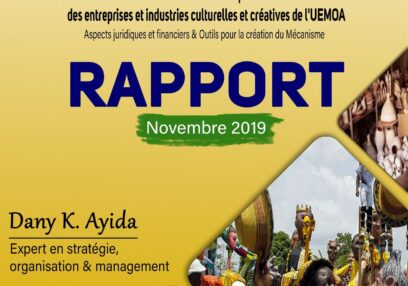
A Comprehensive Study on the Mechanism for Promoting Cultural and Creative Industries and Enterprises within the WAEMU/UEMOA region

The present document outlines the findings of a pivotal study commissioned by the West African Economic and Monetary Union (WAEMU) Commission to establish a dedicated Mechanism for the Promotion of Cultural and Creative Enterprises and Industries within the sub-region. This initiative represents a significant step forward in recognizing and supporting the economic potential of the cultural and creative sector.

Study Mandate and Execution

The study was carried out between 2019 and 2020 by an expert assigned by the consultancy firm, ALG, acting on behalf of the WAEMU Commission. The core objective of this consultancy, as defined by the terms of reference, was to lay the comprehensive groundwork necessary for the successful creation and operation of the mechanism. Specifically, the expert’s mission was threefold:

  1. Defining the Frameworks: To meticulously define the technical, organizational, and management frameworks that would govern the mechanism’s operations, ensuring efficiency, transparency, and relevance to the needs of the cultural sector.
  2. Developing Legal and Financial Aspects: To develop the necessary legal instruments and delineate the financial architecture required for the effective and sustainable establishment of the mechanism, including identifying funding sources and disbursement protocols.
  3. Preparing Specifications: To prepare detailed specifications and guidelines for the potential managers and investors who would be involved in operating and capitalizing the mechanism, ensuring clarity on roles, responsibilities, and expected performance metrics.

Contextual Rationale: The Imperative of Financing

The impetus for this study and the subsequent creation of the mechanism is deeply rooted in the broader reflection surrounding the financing of cultural enterprises in the WAEMU zone. The issue of funding has consistently been central to the Union’s strategy, notably leading to the adoption of the WAEMU Cultural Development Policy in 2013 and its subsequent Program in 2015.

A critical turning point was the 2013 symposium held in Ouagadougou on the theme, “Investing in Culture.” This landmark event gathered cultural entrepreneurs from across the sub-region alongside key partner institutions of the Commission. The central discussion at the symposium revolved around exploring and defining appropriate, sustainable avenues to finance the growth of cultural enterprises that could serve as a viable alternative or complement to traditional subsidies. The consensus was that greater financial innovation and structural support were necessary to unlock the sector’s full economic potential.

The Consultancy and Implementation Phase

Following the recommendations generated by the 2013 symposium, and driven by a need for a detailed assessment of the financing challenges within the Member States’ cultural sectors, the Commission contracted ALG’s services. The official title of the study was: “the legal and financial aspects and Assistance with the creation of the mechanism for the promotion of cultural and creative enterprises and industries in WAEMU.”

Read More

Directory of cultural organizations in West Africa

The general objective of the project of which this contract is a part is as follows: “Support the development of exchanges, networks and cooperation between cultural actors in the region with a view to building a common cultural space.”

The specific objective of the project is to enable the increase in the circulation and promotion of actors, works and cultural information within the region through the development of synergies, complementarities, collaborations and partnerships between cultural actors in the region, through subsidies.

The specific objective of this contract is as follows: Provide the West African cultural sector with an educational and information tool to promote contacts between non-state actors in the sector and thus contribute to the creation and strengthening of regional networks.

The directory includes cultural organizations from the 15 ECOWAS countries and Mauritania.

ALG carried out this mission in 2009, on behalf of UEMOA and ECOWAS, with funding from the European Union.

Read More

Support for the implementation of transitional justice in Burundi

The journey towards lasting peace and reconciliation in Burundi, following years of internal conflict, hinges significantly on the successful implementation of transitional justice mechanisms. This commitment to address past human rights violations and injustices is firmly rooted in the 2000 Arusha Agreement, which laid the groundwork for a comprehensive national approach. The United Nations Development Programme (UNDP), recognizing the complexity and sensitivity of this undertaking, initiated a crucial project in 2009 to provide the necessary methodological support.

Project Overview

Project Title: Development of Methodological Tools for Transitional Justice in Burundi

Client: United Nations Development Programme (UNDP)

Country: Burundi

Year: 2009

The overarching goal of this initiative was to ensure that the process of establishing transitional justice mechanisms was truly inclusive, transparent, and reflective of the Burundian people’s aspirations. The Government of Burundi and the United Nations had jointly agreed on the necessity of establishing these mechanisms, but their formation required broad, inclusive national consultations to garner legitimacy and popular buy-in. To navigate this complex and historically charged process, UNDP sought a specialized firm to develop a robust, culturally sensitive, and appropriate methodology and set of tools for these national consultations.ALG’s Critical Role in Laying the Foundation

Our firm, ALG, was contracted to provide the specialized expertise needed to structure and execute the foundational phase of these national consultations. Our services were meticulously designed to ensure the subsequent consultations were comprehensive, methodologically sound, and yielded actionable results. Our key contributions included:

1. Data Collection and Participant Identification (National consultations)

  • Statistical Mapping: We undertook the vital task of collecting statistical data to facilitate the precise identification and geographical location of potential participants across all segments of Burundian society. This data was crucial for ensuring the consultations were genuinely representative and reached victims, perpetrators, community leaders, women’s groups, youth, and other key stakeholders. The accuracy of this initial step was paramount to the legitimacy of the entire process.
  1. Methodology and Tool Development

  • Designing the Consultative Framework: The core of our mission was the development of a comprehensive methodology and a suite of specialized tools tailored for the unique context of Burundi. This involved creating:
    • Detailed Questionnaires: Structured and semi-structured questionnaires designed to elicit specific information on experiences, perceptions of justice, and recommendations for transitional justice mechanisms.
    • Interview Guides: Flexible guides for in-depth, one-on-one or small-group interviews to capture nuanced narratives and personal testimonies.
    • Facilitation Guides: Detailed instructions and best practices for field teams on leading group discussions, managing sensitive topics, and ensuring safe and respectful dialogue.
    • Counting and Recording Sheets: Standardized forms for accurately documenting and aggregating qualitative and quantitative data collected during the consultations.
  1. Capacity Building and Training
  • Training the Consultative Project Team (CPT): We conducted intensive training sessions for the central Consultative Project Team, equipping them with a deep understanding of the developed methodology, the ethical considerations of transitional justice work, and advanced facilitation techniques.
  • Field Team Preparation: We also trained the extensive network of field teams who would be directly responsible for executing the national consultations across the country. This training focused on the practical application of the tools, culturally sensitive engagement, impartiality, and ensuring the safety and confidentiality of participants.
  1. Analysis and Reporting
  • Analysis of Findings: Following the completion of the consultations, our team was responsible for the rigorous analysis of the vast amount of qualitative and quantitative data collected. This involved identifying key themes, patterns of victimisation, public perceptions of accountability, and preferred models for truth and reconciliation.
  • Development of the General Report: The culmination of our work was the production of a comprehensive General Report on the national consultations. This document synthesized the findings, provided a detailed account of the consultation process, and presented evidence-based recommendations to the Burundian authorities on the structure, mandate, and operation of the future transitional justice mechanisms.

Impact and Outcome

The methodological groundwork laid by this mission proved to be instrumental. The high-quality deliverables—including the proven methodology, trained personnel, and the final comprehensive report—directly supported the Burundian authorities in making informed, nationally-owned decisions. By providing a clear and representative roadmap of the Burundian population’s views, our work significantly contributed to the subsequent process of setting up credible, legitimate, and effective transitional justice mechanisms essential for the consolidation of peace and fostering true reconciliation in the country. This foundational phase ensured that the mechanisms, once established, would be built on a broad national consensus, thereby maximizing their potential for long-term success.

Read More

Formation du personnel de sécurité des aéroports en artificiers-démineurs

L’objectif à court terme de la formation est de réduire les écarts décelés lors des audits de l’Organisation de l’Aviation Civile Internationale (OACI et Federal Aviation Authority (FAA) et d’accroître en nombre et en qualité, l’effectif des agents directement acteurs de l’aspect opérationnel de l’application des mesures de sûreté conformément au programme national de sûreté de l’aviation civile spécialement en artificiers / démineurs.

La formation a été réalisée en deux phases par une équipe d’experts internationaux d’Africa Label Group S.A, pour le compte du Programme Sectoriel des Transports (PST II), financé par la Banque Mondiale.

La formation s’est déroulée en deux sessions avec le programme suivant :

Session 1

  • Les EEI
  • La fouille et recherche d’un parking.
  • La fouille et recherche d’un bâtiment simple.
  • La fouille et recherche d’un bâtiment complexe (étage ou entrepôt ou salle d’embarquement)
  • La fouille et recherche dans un aéronef.
  • Mise en Å“uvre des équipements spécifiques.
  • Entretien et sauvegarde des équipements spécifiques.
  • La check list de fouille et recherche
  • Mise en place des équipements fixes aux accès.

Session 2

  • La gestion du risque
  • Les règles de sécurité lors d’une destruction
  • Les techniques de destruction
  • Les techniques d’intervention
  • Mise en Å“uvre des équipements spécifiques.
  • Entretien et sauvegarde des équipements spécifiques.
  • Management des personnels.
Read More

Burkina Faso: Programme National de Contrôle de la Qualité de la Sûreté de l’Aviation Civile

Titre de la mission: Etude pour l’élaboration du Programme Nationale de Contrôle de la Qualité de la sûreté de l’aviation civile
Client: Agence Nationale de l’Aviation Civile du Burkina Faso

Bailleur de Fonds: Banque Mondiale

Pays: Burkina Faso

Année de réalisation: 2011

Le programme national de contrôle de la qualité de la sûreté de l’aviation civile est une structure, un environnement qui favorise l’excellence dans la mise en application des mesures et un rehaussement de la sûreté de l’aviation.
Il a pour objectifs de :

  • Vérifier la mise en Å“uvre effective des mesures du PNSAC ainsi que de celles contenues
    dans les programmes de sûreté des aéroports et des compagnies aériennes ;
  • Identifier les domaines qui nécessitent une amélioration, ainsi que donner des conseils et
    des avis techniques ;
  • Déterminer l’opportunité et l’efficacité de l’application des dispositions du Programme
    national de sûreté de l’aviation civile à travers l’institution de règlements, de tests,
    d’inspections et d’audits dans le domaine de la sûreté de l’aviation civile ;
  • Contrôler le niveau de conformité avec les dispositions du PNSAC ;
  • S’assurer que les actes d’intervention illicite sont investigués ;
  • Réviser et réévaluer les mesures et les contrôles de sûreté immédiatement après un acte
    d’intervention illicite
  • S’assurer que toutes les personnes auxquelles sont assignées des tâches ou
    responsabilités ou fonctions ont de manière véritable une formation et des instructions pour
    accomplir ces devoirs;
  • Déterminer si le PNSAC est adéquat et efficace, par l’établissement de législation, de
    règlements, d’inspections et d’audits.

Le Programme National de Contrôle Qualité s’applique à l’ensemble des exigences et dispositions
du Programme National de Sûreté de l’Aviation Civile ainsi que des autres règlements dans le
domaine de la sûreté de l’aviation civile.

Read More

Etude sur le système de rémunération des agents de l’Etat du Bénin

  • Titre du projet: Etude sur le système de rémunération des agents de l’Etat
  • Client: Ministère du Travail et de la Fonction Publique du Bénin
  • Bailleur de fonds: Pays-Bas
  • Partenaire d’exécution: cabinet Afrique Conseil
  • Pays: Bénin
  • Année: 2012

Au regard des enjeux connus de la mission, l’étude en plus des résultats qui en sont attendus devrait permettre au Ministère du Travail et de la Fonction Publique (MTFP) et par delà au Gouvernement de disposer d’outils pratiques permettant de :

  • Maîtriser la stratégie et le système de rémunération des agents de l’Etat ;
  • Assurer le contrôle de la masse salariale ;
  • Faire une classification claire des emplois et concevoir des grilles salariales adaptées ;
  • Systématiser les enquêtes de salaire au sein de la fonction publique ;
  • Réussir l’individualisation des salaires ;
  • Maitriser les éléments périphériques de la rémunération ;
  • Disposer d’une politique de rémunération à la hauteur des enjeux et des ambitions de développement du Bénin.

Trois objectifs principaux sont fixés pour l’étude :

  1. Promouvoir une meilleure allocation des ressources budgétaires ;
  2. Accroitre l’équité dans les rémunérations ;
  3. Mettre en place un système de rémunération qui permet de motiver les agents de l’Etat.

Deux axes clés de l’intervention:

  • Analyser le système de rémunération des agents publics du Bénin, sa structure, ses composantes et son niveau par rapport au secteur non public, les logiques, paramètres et facteurs de son évolution en vue de sa rationalisation;
  • Mener des enquêtes comparatives avec le secteur non public et procéder à une analyse comparative des données de l’enquête avec l’état des lieux du système de rémunération et avantages des agents de l’Etat.
Read More

Diagnostic study of the legal and judicial system of Burundi

  • Project Title: Diagnostic Study of the Legal and Judicial System of Burundi
  • Client Name: Economic Management Support Project
  • Funder: World Bank
  • Country: Burundi
  • Year of Implementation: 2008

The legal study of the legal and judicial system of Burundi is a project of the Ministry of Justice of Burundi, financed by PAGE/World Bank. The study takes stock of the overall situation of justice in relation to the legal arsenal and proposes reforms to enable the country to return to normality and good governance.

The services provided in this context by ALG experts are:

  • Data collection on the Burundian legal system,
  • Inventory of the judicial system,
  • Development of the strategic plan for justice reform
  • Presentation of the results of the study during a restitution workshop

Judicial Reform in a Post-Conflict Country: ALG’s Approach for Burundi

Context

  • Post-Conflict Landscape: Burundi’s judicial system, like many others in post-conflict settings, was severely damaged by the armed conflict. This damage manifests in various forms, including:
    • Physical Destruction: Courthouses and legal records may have been destroyed.
    • Loss of Personnel: Judges, lawyers, and other legal professionals may have been killed, fled the country, or been otherwise incapacitated.
    • Weakened Institutions: The rule of law and public trust in the justice system may have been severely eroded.
    • Corruption and Impunity: Conflict often exacerbates existing corruption within the justice system and creates a culture of impunity for those who committed crimes during the conflict.
  • Need for Reform: Rebuilding the judicial system is essential for post-conflict reconstruction, reconciliation, and the establishment of lasting peace.

Understanding the Challenges

  • Lack of Resources: Post-conflict countries often lack the financial and human resources necessary to effectively reform the judiciary.
  • Political Interference: The judiciary may be subject to political pressure and interference from various actors, undermining its independence and impartiality.
  • Resistance to Change: There may be resistance to reform from within the judiciary or from other powerful groups who benefit from the status quo.
  • Security Concerns: Insecurity and ongoing violence may hamper reform efforts and create risks for judicial personnel.

The ALG’s Approach

  • Holistic Strategy: ALG recognizes that judicial reform requires a comprehensive and multi-faceted approach that addresses the root causes of the problems within the justice system.
  • Focus on Capacity Building: ALG prioritizes building the capacity of judicial personnel through training, mentoring, and other forms of support.
  • Strengthening Institutions: ALG works to strengthen judicial institutions by promoting transparency, accountability, and the rule of law.
  • Promoting Independence: ALG advocates for the independence of the judiciary and works to protect it from political interference.
  • Community Engagement: ALG recognizes the importance of community engagement and participation in the justice system and works to build public trust and confidence in the judiciary.

Key Areas of Intervention

  • Legal Framework: ALG recommended the reviewing and reforming laws and legal procedures to ensure they are fair, just, and consistent with international human rights standards.
  • Judicial Infrastructure: ALG suggested the reconstruction and rehabilitation of courthouses and other judicial infrastructure.
  • Human Resources: ALG recommended the recruitment, training, and retaining qualified judicial personnel.
  • Access to Justice: ALG recommended to work to improve access to justice for all, particularly for marginalized and vulnerable groups.
  • Transitional Justice: ALG proposed to support transitional justice mechanisms, such as truth commissions or special courts, to address past human rights abuses.

Judicial reform in post-conflict countries is a complex and challenging process, but it is essential for achieving lasting peace and stability. ALG’s approach, which emphasizes capacity building, institutional strengthening, and community engagement, offers a promising model for effective judicial reform in Burundi and other post-conflict settings.

Read More